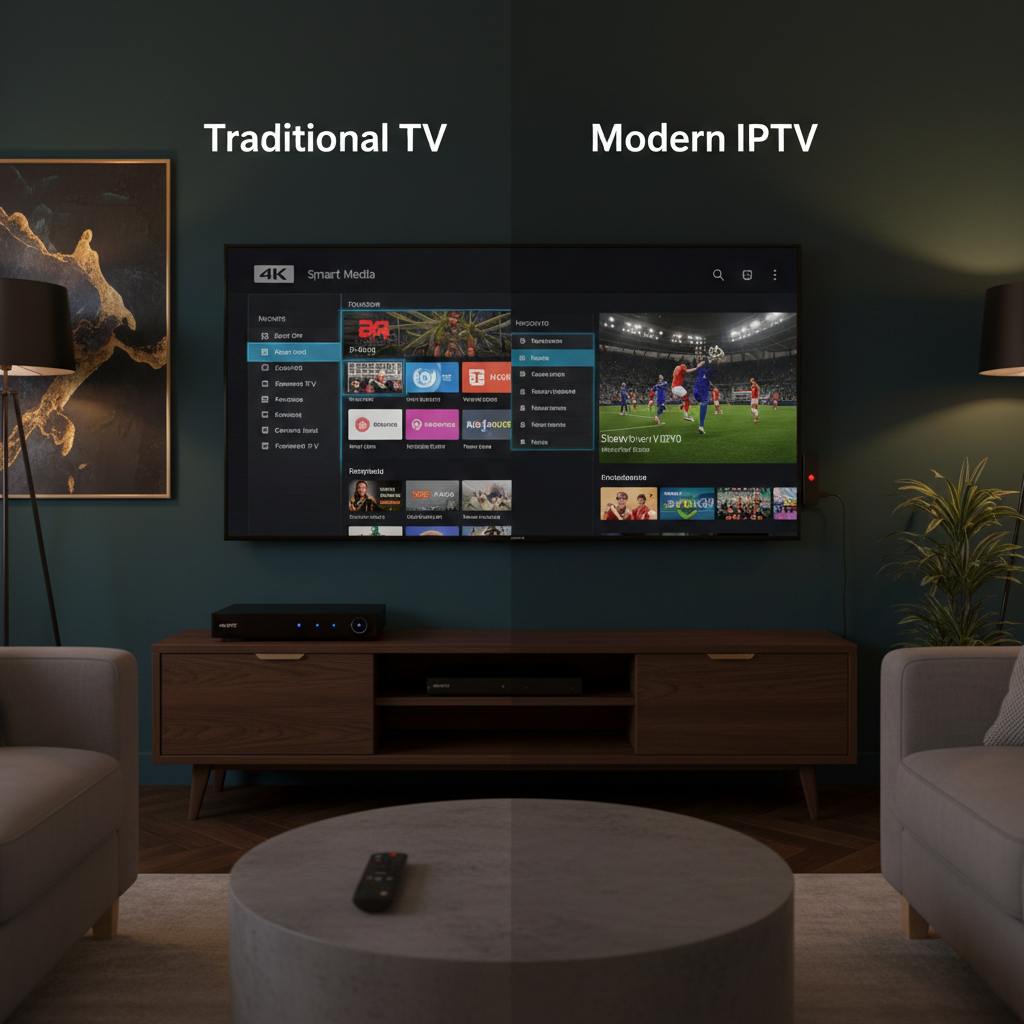
For most UK households in 2026, the real answer is this: IPTV isn’t automatically “better” than Sky, Virgin or BT — but it is often more flexible and potentially far cheaper if you already have strong broadband. The better option depends on what you value most: contract-backed stability and bundled services, or app-based freedom across devices with lower monthly costs.
Picture a typical home paying £80–£120 per month for a Sky or Virgin bundle. You get live TV, maybe sports, broadband, and a set-top box in the living room. But then you still subscribe to Netflix, Prime Video, or Disney+ because not everything you want is included. Over time, the cost creeps up, and the setup becomes fragmented. That’s where IPTV enters the conversation. Instead of a fixed box and long contract, IPTV services run through apps on Fire Stick, Android TV, Smart TVs, or even mobile devices — often with broader channel access in one interface.
The main difference lies in structure. Sky, Virgin Media, and BT TV operate through managed infrastructure with defined channel packages and 18–24 month contracts. Installation, equipment, and sometimes engineer visits are part of the process. IPTV works over your existing broadband connection. There’s no dish, no dedicated TV box required beyond a streaming device, and no long-term tie-in in most cases. However, reliability shifts from satellite infrastructure to internet stability. If your broadband is strong and stable, IPTV can feel smooth and modern. If your connection struggles during peak hours, traditional providers may feel more predictable.
Cost is often the trigger for comparison. Traditional UK telecom bundles combine TV and broadband, which can make them convenient but expensive. IPTV subscriptions are usually standalone and rely on broadband you already pay for. That can reduce overall monthly spending, especially for households that mainly want live sports, UK entertainment, and multi-device access. The comparison overview above highlights this shift clearly: one path prioritises structured contracts and bundled services, the other prioritises flexibility and device freedom.
So is IPTV better — or just different? If you want guaranteed infrastructure, bundled billing, and minimal setup thinking, Sky, Virgin, or BT may suit you. If you want flexibility, app-based viewing, and potentially lower monthly cost with the right setup, IPTV can be a strong alternative. The right choice depends less on brand loyalty and more on how your household actually watches TV in 2026.
Quick takeaway:
IPTV offers flexibility and lower entry cost if broadband is strong.
Sky, Virgin, and BT offer structured bundles with contract stability.
Your ideal choice depends on viewing habits, not just price.
Quick Comparison Table (2026 Overview)
If you want a fast answer, here it is: Sky, Virgin Media and BT offer structured bundles with long-term contracts and managed infrastructure, while IPTV services focus on flexibility, app-based access and lower entry cost — but depend entirely on your broadband quality. The right choice comes down to whether you prefer contract-backed predictability or device-based freedom.
Here’s a simplified 2026 overview based on how most UK households experience these services:
| Feature | IPTV | Sky | Virgin Media | BT TV |
|---|---|---|---|---|
| Monthly Cost | Usually lower (standalone subscription) | Higher (bundle-based) | Higher (bundle-based) | Mid to high (bundle-based) |
| Contract | Often monthly / flexible | 18–24 months | 18 months+ | 18–24 months |
| Hardware | Fire Stick, Android TV, Smart TV apps | Sky Q / Sky Stream box | Virgin 360 box | BT TV box |
| Installation | App-based, no engineer | Often required | Often required | Sometimes required |
| Peak-Time Stability | Depends on broadband + provider | Managed network | Managed network | Managed network |
| Multi-Device Use | Flexible across devices | Extra cost for multiroom | Extra cost | Extra cost |
As the comparison above shows, traditional providers bundle broadband and TV together. That can simplify billing, but it also increases total cost. A household paying £90 per month for Virgin Media TV and broadband might still add Netflix or Prime Video on top. IPTV services, by contrast, use broadband you already pay for and run through apps on Fire Stick or Android TV, which many UK homes already own.
The trade-off is infrastructure. Sky and Virgin rely on managed delivery systems, which many users see as stable and predictable. IPTV relies on internet streaming. With strong fibre broadband, IPTV can feel just as smooth and far more flexible. With weak Wi-Fi or peak-time congestion, performance may vary. This is why device quality and internet stability matter more in an IPTV setup than with satellite or cable.
If your priority is simplicity and one bundled provider, Sky, Virgin Media or BT TV may feel safer. If your priority is flexibility, cost control and watching across multiple rooms without extra hardware fees, IPTV often appeals more to modern households. The visual comparison above highlights this difference clearly — structure versus flexibility.
Quick takeaway:
Traditional providers = contracts and bundled stability.
IPTV = flexibility and lower hardware dependency.
Broadband quality is the deciding factor for IPTV performance.
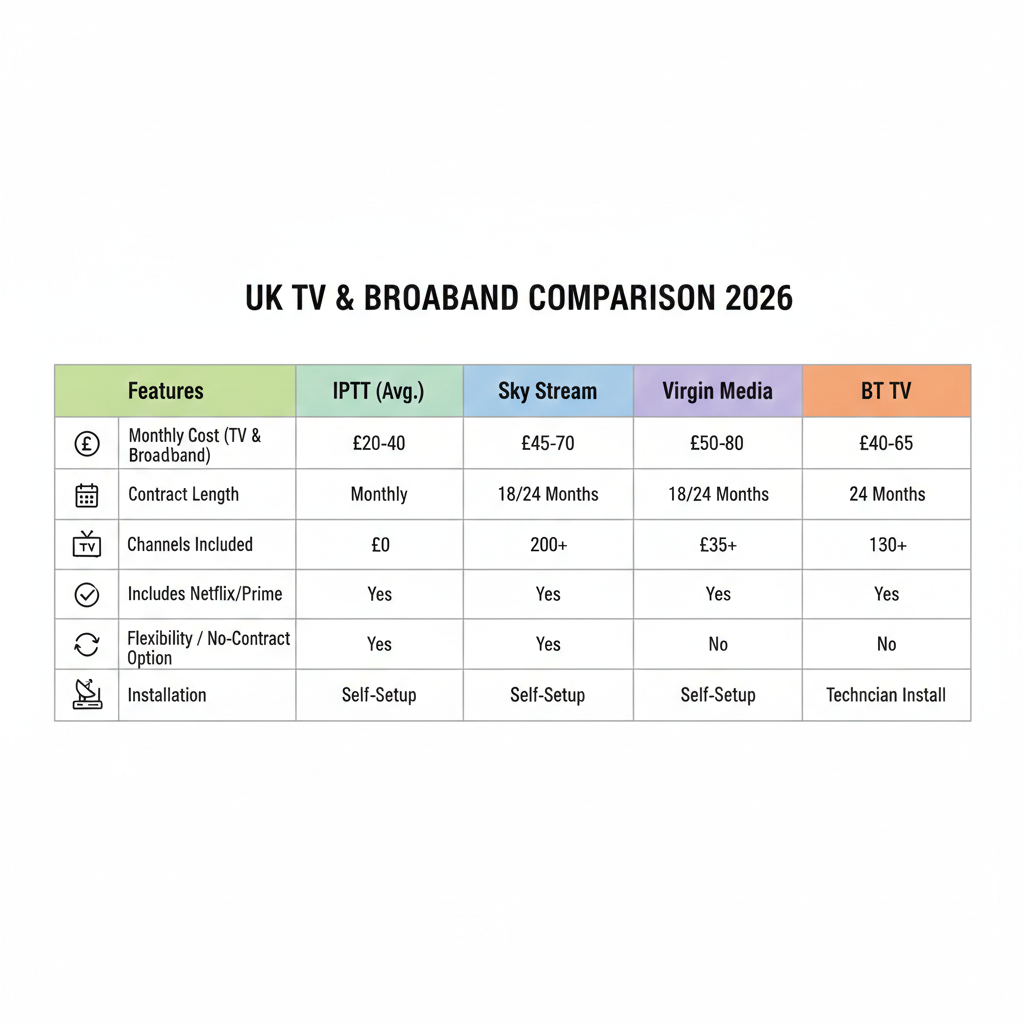
Pricing in 2026 — What Are You Really Paying For?
In 2026, you’re not just paying for TV — you’re paying for infrastructure, contracts, equipment, and flexibility. The real difference between IPTV and Sky, Virgin Media, or BT TV isn’t just the monthly number on your bill. It’s what that number includes, how long you’re locked in, and how much control you actually have over your setup.
A typical UK household bundle from Sky or Virgin Media often ranges between £70 and £120 per month once sports, HD/UHD options, and broadband are included. Add multiroom access, premium channels, or faster fibre packages, and costs can climb even higher. BT TV sits in a similar bracket when combined with broadband and sports add-ons. What many households don’t notice at first are the extras: set-top box rental, installation fees, activation charges, and early exit penalties if you cancel mid-contract. Over an 18–24 month term, that total commitment can be significant.
IPTV services work differently. They usually operate as standalone subscriptions that run on devices you already own, such as Fire Stick, Android TV, or Smart TVs. There’s no engineer visit, no dish, and often no long-term contract. That flexibility can reduce upfront and long-term costs, especially if you already pay for strong broadband. Instead of bundling everything into one telecom contract, IPTV allows you to separate internet and TV. For some households, that separation creates savings. For others, especially those who value bundled simplicity, traditional providers still feel more convenient.
The question most people ask is: is IPTV actually cheaper? In many cases, yes — but only if your broadband is stable and you choose a reliable IPTV service. If buffering forces you to upgrade internet or constantly troubleshoot weak providers, the value equation changes. The pricing visual above reflects this clearly: traditional TV spreads cost across hardware, contracts, and brand infrastructure, while IPTV shifts cost toward broadband performance and provider quality. Understanding that difference helps you decide whether you’re paying for stability, convenience, or flexibility.
Quick takeaway:
Traditional bundles include infrastructure and long contracts.
IPTV focuses on app-based access with fewer hardware costs.
The real cost depends on broadband quality and provider reliability.

Reliability & Peak-Time Performance (7–10pm UK Test)
When comparing IPTV vs Sky, Virgin & BT in 2026, reliability during peak evening hours is the real deciding factor. Between 7pm and 10pm, UK households are streaming live sports, entertainment, and on-demand content simultaneously. This is when weaker systems struggle and stronger infrastructure proves itself.
Traditional providers like Sky and Virgin Media operate on managed networks or satellite systems. Their delivery model is built for high-demand periods, which often results in consistent performance during major events. If you’re watching Premier League football at 8pm on a Sky Q box, the stream is unlikely to buffer because it isn’t relying purely on open internet routing. That controlled infrastructure is part of what you’re paying for in a long-term bundle.
IPTV services, by contrast, rely on broadband stability and provider server capacity. With strong fibre broadband and a well-managed IPTV service, performance can be equally smooth. But if the provider oversells subscriptions or your ISP applies traffic shaping, buffering can appear precisely when demand spikes. This is why the 3pm vs 9pm test is so important. Watch the same channel mid-afternoon, then again during peak hours. If stability drops only in the evening, you’re likely dealing with congestion or server load rather than device issues.
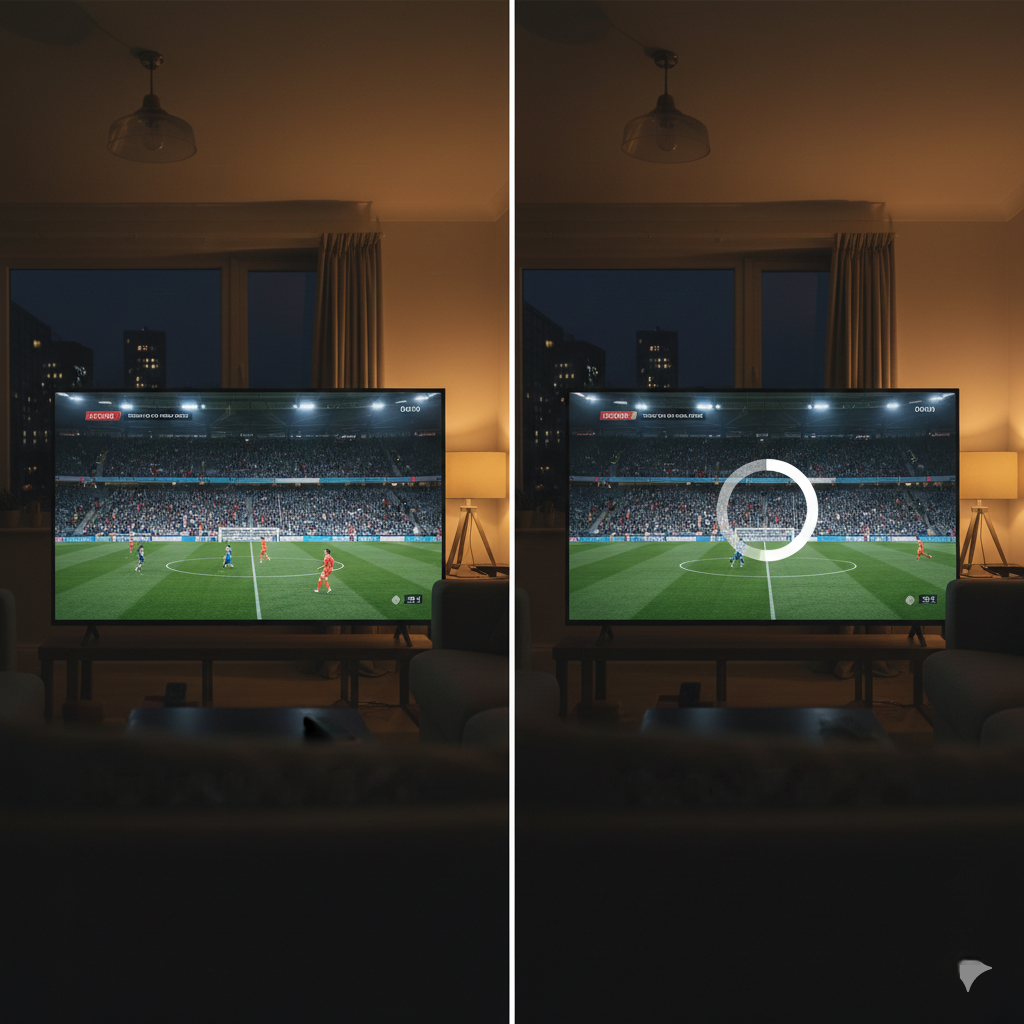
What does “stable” actually look like during peak time? Channels should load quickly, HD quality should remain consistent, and switching between streams should not trigger repeated loading screens. Audio should stay in sync, and the EPG should update normally. The comparison visual above illustrates this clearly: peak-time reliability is less about brand names and more about infrastructure strength and broadband quality.
If your broadband is strong and consistent, IPTV can perform extremely well even during busy hours. If your internet fluctuates or your provider lacks proper anti-freeze infrastructure, traditional services may feel more dependable. The key is testing under real conditions before deciding which system truly meets your household’s expectations.
Quick takeaway:
Peak-time (7–10pm) performance reveals true reliability.
Managed satellite/cable networks are often more predictable.
IPTV depends heavily on broadband stability and provider capacity.
Device Flexibility — Fire Stick vs Set-Top Boxes
When it comes to device flexibility, IPTV clearly has the advantage — but that flexibility comes with different responsibilities. Traditional providers like Sky, Virgin Media, and BT TV revolve around dedicated set-top boxes. IPTV services revolve around apps and streaming devices such as Fire Stick, Android TV, and Smart TVs.
With Sky Q, Virgin 360, or BT TV, the experience is tightly controlled. You receive a branded box, a remote, and a structured interface designed specifically for that service. It’s simple: plug it in, connect it, and everything works within their ecosystem. Multiroom access is possible, but usually at an extra monthly cost. If you want another TV in the bedroom, you typically need another box or add-on subscription.
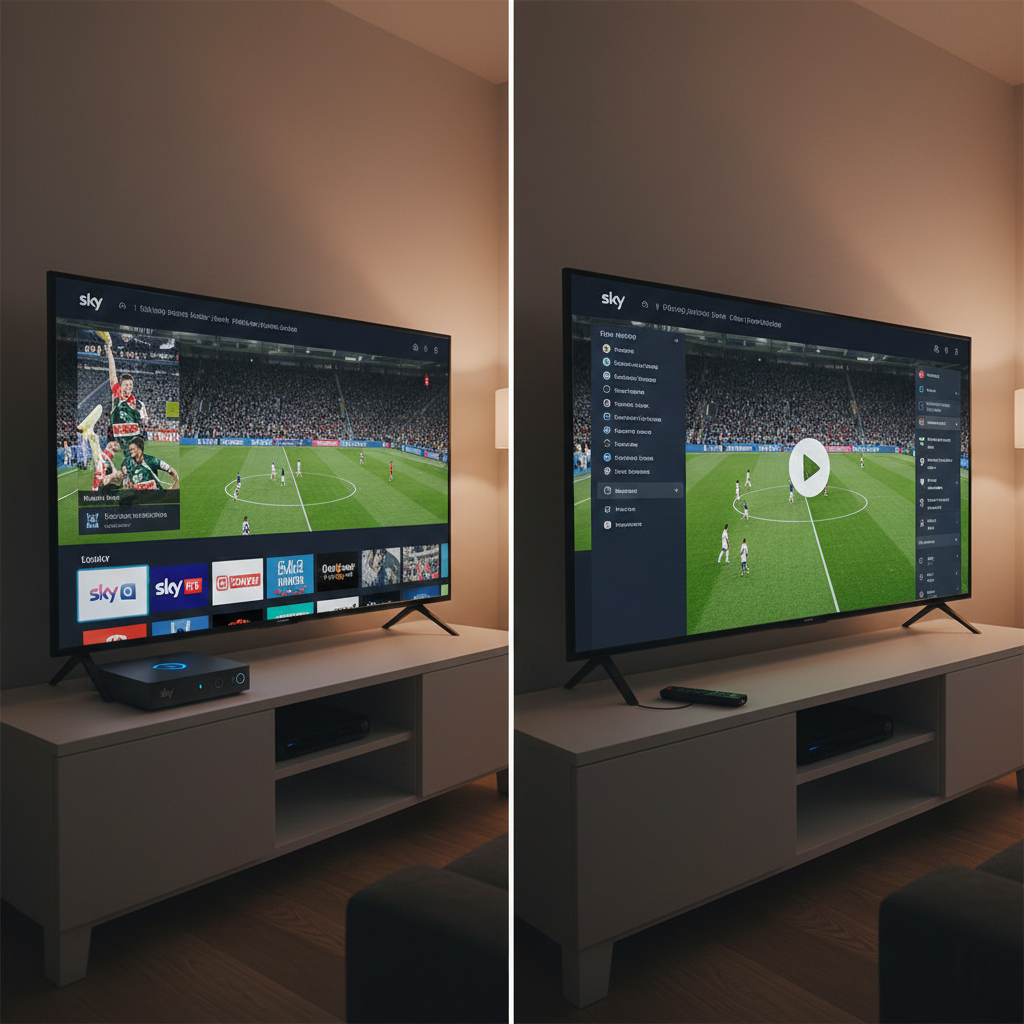
IPTV flips that model. Instead of relying on a single provider box, it runs through streaming apps installed on devices many households already own. A Fire Stick in the living room, an Android TV in another room, and even a tablet or mobile device can all access the same service. This flexibility is one of IPTV’s strongest appeals in 2026, especially for households that don’t want extra hardware clutter or rental fees. The comparison visual above highlights this contrast clearly: one path uses provider-controlled hardware, the other uses open app-based access.
However, flexibility also means your setup matters more. With IPTV, performance depends on the quality of your streaming device and your broadband. An older Smart TV may struggle with heavy apps, while a modern Fire Stick typically offers smoother performance and better app optimisation. Traditional set-top boxes are built for one purpose and are usually stable within their ecosystem. IPTV setups require a bit more awareness, especially when managing storage, updates, and Wi-Fi strength.
If your priority is plug-and-play simplicity, set-top boxes still offer a structured experience. If your priority is watching across multiple rooms and devices without paying extra hardware fees, IPTV often feels more modern and adaptable. The right choice depends on whether you prefer controlled infrastructure or device freedom.
Quick takeaway:
Set-top boxes offer structured simplicity.
IPTV offers multi-device flexibility.
Device quality and broadband stability matter more with IPTV.
Content Coverage — Sports, Entertainment & International Channels
When it comes to content coverage, the difference between IPTV and traditional providers isn’t just about how many channels you get — it’s about how they’re packaged and accessed. Sky, Virgin Media and BT TV organise content into structured bundles: sports packages, entertainment tiers, cinema add-ons. IPTV services often present a broader mix of live TV, VOD, and international channels within one app-based system.
Sports is usually the deciding factor for UK households. Sky Sports, TNT Sports (formerly BT Sport), and Premier League rights are traditionally tied to major telecom packages. With Sky or Virgin, access is clear but expensive, and often locked behind specific bundles. IPTV can offer wider sports coverage within a single subscription, including UK and international feeds. However, performance during live events depends heavily on provider stability and broadband quality. If live sport is your priority, reliability during peak matches matters more than raw channel numbers.
Entertainment channels follow a similar pattern. Traditional providers focus on well-known UK networks, structured catch-up services, and integrated on-demand libraries. The interface feels familiar and polished. IPTV services often combine UK channels with a larger mix of international options, niche networks, and broader VOD libraries. For multilingual households or viewers wanting international sports and entertainment, this flexibility can be appealing. The comparison overview above highlights how IPTV’s strength lies in variety, while Sky and Virgin focus on curated, branded ecosystems.
International content is where IPTV often stands out. Traditional UK bundles are primarily domestic, with international add-ons costing extra. IPTV services commonly include channels from Europe, the US, and beyond within the same system. For families with global interests, this can reduce the need for multiple separate subscriptions. That said, organisation and EPG quality vary by provider, so structure matters just as much as availability.
The key question isn’t which option has “more” — it’s which one matches how you actually watch TV. If you mainly watch UK sports and familiar channels, traditional providers may feel sufficient. If you want broader access across sports, entertainment, and international channels in one place, IPTV can offer a more consolidated experience.
Quick takeaway:
Traditional providers offer structured UK-focused bundles.
IPTV often delivers broader international and mixed coverage.
For live sports, reliability matters more than channel count.
Contracts vs Flexibility
The biggest structural difference between IPTV and Sky, Virgin or BT isn’t content — it’s commitment. Traditional UK TV providers are built around contracts, while IPTV services are usually built around flexibility. Whether that’s a benefit or a risk depends on how much certainty you want in your setup.
Sky, Virgin Media and BT TV typically require 18–24 month agreements. In exchange, you get bundled broadband, managed infrastructure, customer service channels, and predictable billing. For some households, that long-term contract brings peace of mind. You know what you’re paying each month, you have official support, and your service is unlikely to disappear overnight. The downside is reduced freedom. Cancelling early often means exit fees, and upgrading or downgrading packages can be complicated.
IPTV services operate differently. Most are monthly subscriptions with no long-term tie-in. If you’re unhappy with performance, you can switch. If you want to test a service for sports season only, you can. That flexibility is attractive to households who don’t want to commit to multi-year contracts. It also aligns with modern viewing behaviour, where people move between platforms depending on events or budgets. The comparison overview above reflects this contrast clearly: contract-based stability versus month-to-month adaptability.
However, flexibility also shifts responsibility to the user. With IPTV, you manage your device, broadband quality, and provider selection. There’s no engineer visit or hardware guarantee. If your broadband changes or your provider underperforms, you need to evaluate and adjust. Some households prefer the structured simplicity of a telecom bundle; others prefer the freedom to change services quickly without penalties.
When deciding between contracts and flexibility, ask yourself a practical question: do you value long-term stability and bundled services, or the ability to change and control your TV setup without restrictions? That answer often determines which system feels more comfortable in everyday use.
Quick takeaway:
Traditional TV providers prioritise contract stability.
IPTV prioritises monthly flexibility and user control.
Your comfort with commitment vs freedom is the deciding factor.
Who Should Choose What? (Decision Framework)
The best choice between IPTV and Sky, Virgin or BT depends less on brand reputation and more on your household habits. There isn’t a universal winner — there’s a better fit based on how you watch, how stable your broadband is, and how much flexibility you want.
Choose Sky, Virgin Media or BT TV if you value structured simplicity. If you prefer one bill, one provider, and a managed system that rarely requires troubleshooting, traditional TV bundles make sense. Households that don’t want to think about device settings, app updates, or broadband optimisation often feel more comfortable with a set-top box and long-term contract. If live sports reliability during peak hours is your top priority and you want minimal involvement in setup, traditional providers may feel safer.
Choose IPTV if you value flexibility and device freedom. If your home already has strong fibre broadband and you’re comfortable using Fire Stick or Smart TV apps, IPTV services can offer broader access across multiple rooms without extra hardware rental fees. Families who move between devices, travel frequently, or want international channel access often prefer the app-based model. If cost control matters and you dislike long-term contracts, IPTV can provide more control over monthly spending.
There’s also a middle ground. Some UK households keep broadband with a major ISP but switch TV to IPTV for flexibility. Others use traditional TV for sports season and adjust later. The key is testing under real conditions. As shown in the comparison overview above, peak-time stability and device performance reveal more than marketing claims. If your broadband performs well at 8–10pm and your setup feels smooth, IPTV can be a practical long-term solution. If not, traditional providers may justify their higher cost.
Simple decision checklist:
Choose traditional TV if:
- You prefer contract-backed stability.
- You don’t want to manage apps or devices.
- You value managed infrastructure over flexibility.
Choose IPTV if:
- You want multi-device access without extra box fees.
- You prefer monthly flexibility.
- Your broadband is strong and consistent.
Quick takeaway:
There is no universal “best” option — only the best fit.
Stability preference favours traditional providers.
Flexibility and cost control favour IPTV.
FAQ (Semantic SEO Booster)
Here are the most common questions UK households ask when comparing IPTV with Sky, Virgin and BT — answered clearly and practically.
Is IPTV legal in the UK?
IPTV as a technology is legal. It simply means television delivered over internet protocol instead of satellite or cable. Legality depends on the provider and whether they hold proper broadcasting rights. That’s why it’s important to choose established, transparent IPTV services rather than unknown sources promising unrealistic channel access for extremely low prices. If you are unsure, focus on providers that clearly explain their service structure and support policies.
Is IPTV more reliable than Sky or Virgin?
Reliability depends on infrastructure and broadband quality. Traditional providers like Sky and Virgin operate controlled networks and dedicated hardware, which often results in stable performance. However, a well-structured IPTV service running on strong fibre broadband can deliver very similar peak-time stability — especially on modern devices like Fire Stick and Smart TVs. The key factor is not the technology itself, but how well the provider manages server capacity and how stable your home connection is during 7–10pm viewing hours.
Do I need special equipment for IPTV?
In most cases, no. IPTV runs through apps on devices such as Amazon Fire Stick, Android TV boxes, Smart TVs, tablets and smartphones. Unlike Sky or BT, you usually don’t need a dedicated set-top box or engineer installation. What you do need is consistent broadband and a compatible device. Many UK households already own everything required without realising it.
Can I cancel IPTV anytime?
Most IPTV subscriptions operate on a monthly basis, meaning you can renew or stop without long-term contracts. This is one of the main differences compared to traditional 18–24 month agreements. However, flexibility also means you should test stability early and choose carefully, as service quality varies between providers.
Which is better for sports in 2026?
Traditional providers still hold exclusive rights to certain major UK sports packages. IPTV services often provide broader international sports coverage and multi-device access. The better option depends on whether you prioritise official bundled rights with contract stability, or broader channel access with device flexibility.
Quick takeaway:
IPTV legality depends on the provider, not the technology.
Reliability is influenced by infrastructure and broadband quality.
IPTV requires compatible devices, not special installation.
Flexibility is one of IPTV’s biggest advantages over contracts.